Frequently Asked Questions
Straight answers to the questions homeowners ask us most about chimney sweeping, inspections, creosote, and chimney safety.
Ready to book? Start with Chimney Sweeping.
What is a CSIA certified chimney sweep?
The Chimney Safety Institute of America (CSIA) is a non-profit organization based in Indiana and is governed by volunteer industry professionals and technical experts from across the country. The CSIA Certified Chimney Sweep® (CCS) credential was established over 30 years ago as a method for homeowners to measure a chimney sweep’s technical expertise. The CSIA is accredited by the Indiana Commission on Proprietary Education.
In order to become a CSIA certified chimney sweep, a chimney sweep has to be familiar with the Successful Chimney Sweeping Handbook, written by the CSIA to encompass all of the elements involved with chimney sweeping. A chimney sweep also has to attend training classes to know the codes and standards of the chimney industry. These codes and standards include the NFPA-211 Standard for Chimneys, Fireplaces, Vents, and Solid Fuel-Burning Appliances (National Fire Protection Association) and the International Residential Code (IRC). Every Certified Chimney Sweep also agrees to abide by a stringent code of ethics. If a CSIA Certified Chimney Sweep is found to be in violation of this code of ethics, the CSIA may revoke their certification standing.
The CSIA maintains an up-to-date searchable database of certified chimney sweeps on its website www.csia.org so that homeowners can find a certified sweep in their area.
While some states mandate that a chimney sweep be certified, currently New Hampshire and Maine laws do not require this.
In addition to certifying chimney sweeps, the CSIA’s mission includes public and professional education with a commitment to the elimination of residential chimney fires, carbon monoxide intrusion and other chimney-related hazards that result in the loss of lives and property. The CSIA devotes its resources to educating the public and related industries through traditional and social media and its relationships with affiliated trades such as home inspectors, realtors, and oil heating service managers.
What is involved with a chimney sweeping?
When we go to a client’s home to sweep a fireplace, wood stove, or pellet system, we take great care in making sure that the home stays clean. The first thing we will do is spread out large canvas drop cloths to protect your flooring and any surrounding items from soot and dust. If we are sweeping a fireplace, we will also tape a canvas cloth to cover the opening. We will then look at your appliance to determine if it is in good working order. Some questions we may ask you are:
–Have you had any problems with the system?
–How old is your wood stove, wood stove insert, pellet stove?
–How much fuel have your burned since it was last swept?
Next, we will set up our vacuum (equipped with a Hepa filter). Whenever possible, we will go up onto the roof to sweep from the top down. Sometimes this is not possible because of the type of appliance, the chimney design or because of the weather, and we will sweep the flue from the bottom. Before we begin sweeping, we look up inside the flue to determine the size and type of chimney brush we should use.
In a masonry fireplace, we look at the type of build-up in the system to best determine the brushes and methods to use in order to get out the most amount of soot and/or creosote while maintaining the integrity of the system. Most soot (Class-1 creosote) can be removed with a soft bristle brush that we attach to rods. There are some occasions where an excessive amount of build-up requires a stiffer metal brush be used in order to sweep the flue.
Sweeping a prefabricated fireplace is different than sweeping a masonry fireplace. In a prefabricated fireplace, the sweeping must be done with a poly-type brush; otherwise, the manufacturers’ warranty becomes void and the system could be damaged.
For wood stoves, the type of liner often dictates what type of brush we can use. Clay flue tiles and heavy gauge stainless steel liners can be swept with either a soft bristle brush or a metal brush, depending on the build-up found in the system. Lighter gauge stainless steel liners can only be swept with the soft bristle brushes, otherwise, the liner could be damaged.
As we begin sweeping, we will have the vacuum running to collect any airborne particles. Unfortunately, the vacuum is really noisy! Once we have finished sweeping the system, we will use the vacuum to pick up any large pieces of debris that have fallen from the flue. If it is a fireplace, we will also sweep/vacuum the top of the smoke shelf. If it is a wood stove, we will take the black pipe outside of the house and clean the inside of the pipe, using a bucket to collect the debris.
We will then look up the flue again to make sure we removed the debris. We will also do a Level 1 visual inspection of the flue’s interior. Once we have completed our inspection, we will talk to you to let you about your system and answer any questions you may have.
How do I know if my chimney needs to be swept?
The National Fire Protection Association in its Standard for Chimneys, Fireplaces, Vents, and Solid Fuel-Burning Appliances standard (also known as NFPA-211) states that “Chimneys, fireplaces, and vents shall be inspected at least once a year.” The chimney or vent’s purpose is to provide “a flow sufficient to remove completely all flue or vent gases to the outside atmosphere.” A blocked chimney or vent could allow smoke and/or carbon monoxide to flow into the home instead of outside, so it is important to have your system checked out every year.
Having a chimney, fireplace, or vent inspected does not necessarily mean it also needs to be swept. The need for a chimney sweeping is dependent upon several factors, such as
- What type of fuel are you burning (wood or pellet)?
- How is it burned? Do you “bank” your stove (have long, slow fires by reducing air flow)?
- When was the last time you had your chimney swept?
- How much wood/pellets have you burned since your last sweeping?
- Are you experiencing any issues with your wood/pellet stove or fireplace?
A good “rule of thumb” is to have your chimney swept after you’ve burned 2 cords of wood or 2 tons of pellets. However, there are always exceptions to every “rule.” For example, if you “bank” your stove, the proper temperature and oxygen requirements for complete combustion are not met. This results in a thicker, denser smoke entering the flue. This smoke contains less heat, so it will cool quickly and condense before it reaches the outside atmosphere. The result is a heavy build-up of soot and creosote. This build-up will impact your draft because it is constricting air flow in the flue. You may start to notice that your stove is harder to start and/or you may experiencing smoking issues with your stove. Large amounts of creosote in a chimney flue or vent is dangerous. The dry, flaky type of creosote ignites easily and can cause a significant chimney fire. The hard, shiny black deposits of creosote are harder to ignite, but if they do, they burn with great intensity at extremely high temperatures, which will more than likely damage your flue. So, if you “bank” your stove, you may want to have your chimney swept more often than once a year if you use your stove often.
For pellet stoves, the main concern is the build-up of ash in the flue or vent. If left unchecked, the ash will build up to a point where the air flow becomes too constricted and the pellet stove will pull the air it needs down from the chimney instead of from the house. This results in ash “blow back” into the house. If the stove is running during an “ash blow back,” the ash will mix with the burning pellets and potentially damage the stove.
For oil burners and oil boilers, the flues should be inspected annually. However, under normal circumstances, the only times an oil flue would need to be swept is when there have been issues with the burner/boiler’s operation.
What is a mechanical sweeping?
A mechanical sweeping requires a set of special rods and a plastic head that spins on the end of the hand-held drill to remove Class-2 creosote, which has a crispy appearance.
In certain situations, we need to use a set of chains which we call Ro-kleening. These chains attach to special metal rods which then fit onto a hand-held drill in order to remove Class-3 creosote, which is a sticky, tar-like substance. We believe that this type of sweeping should only be used if there is no other recourse. This is a very aggressive cleaning technique and will reveal issues such as holes between the mortar joints or cracks in the flue tiles previously hidden by the creosote. However, this technique also has the potential to damage the interior structure of the flue and should never be done by someone who is untrained or uncertified.
A new product has recently come on the market, called Poultice Creosote Remover (PCR). This product is designed to completely remove Class-3 glazed creosote from clay flue tiles or stainless steel chimney liners. The PCR can be applied by brush for reachable places or can be pulled up the flue with a specially designed tool which is attached to a winch at the top of the chimney. PCR dissolves the creosote, absorbs it, then dries and falls down the flue. Any remaining PCR is then removed by a normal chimney sweeping. A PCR application takes two visits – one to apply the product and then a follow up visit to remove the dried creosote and any residual product left inside the flue.
What is creosote?
Creosote is a natural byproduct of burning wood. When a wood fire is burning, there needs to be enough oxygen to have proper combustion so that the wood smoke can go up and out of the chimney flue. Creosote comes from condensed wood smoke, which occurs when wood smolders—when its airflow has been reduced or restricted, or when there is too much airflow which causes the wood smoke to cool down too fast, resulting in condensation and creosote deposits inside the flue . This condensed wood smoke is made up of tar droplets, vapors, and other organic compounds. As the tar droplets and vapors rise up the flue, they condense as a liquid onto the inside of the chimney because there is not enough heat to carry them up and out.
Normal soot deposits are soft and black/brown in color. Creosote deposits are usually dark brown or black in color. They can appear watery or tar-like depending on the mixture of tar and vapors. Once inside the chimney, creosote often changes form because of pyrolysis (the chemical alteration of fuel molecules as a result of heat).
Sooty, ash-like deposits are common in fireplaces. The soot is often mixed with fly ash (ashes that are carried up into the flue by the draft). This type of creosote is often referred to as Class 1 creosote. While these deposits are less combustible than other forms of chimney deposits, they still present a fire hazard. Regular sweeping helps to prevent flue blockages, moisture retention, chimney odors, and most importantly, chimney fires.
Class 2 creosote looks like dry, flaky black deposits and are the result of tar deposits that have been heated and pyrolyzed. This type of creosote ignites easily and can cause a significant chimney fire.
The worst type of creosote is the hard, shiny black deposits. They are a form of tar glaze that has been baked onto the chimney flue walls. These deposits are more difficult to ignite. However, if they do ignite, they would burn at extremely high temperatures, which could cause significant damage to the chimney and the home.
There are several variables that contribute to build up of creosote: Smoke Density, Flue Gas Temperature, and Residence Time. Smoke density refers to the amount of unburned hydrocarbons in the wood gas. Generally, the smokiest fires produce the most amount of creosote. Low air supply causes high smoke density. “Banking” a wood stove (filling the stove with wood and then reducing the air flow so that the fire “burns”/smolders all night) oftentimes results in the accumulation of creosote. Flue Gas temperature refers to the temperature of the gases entering the chimney. The flue gas temperature is influenced by the chimney type, its size and location, and by the appliance type and usage. For example, uninsulated chimneys located on exterior walls of a home are colder than those that are located on the interior walls or those that are insulated. Colder chimneys cool the smoke vapors, which results in the vapors condensing and depositing creosote on the interior of the chimney. Residence Time refers to the length of time the smoke is in the venting system/flue. If the area of the flue is too large, the flow rate of the smoke will be slow. The smoke will remain in the chimney longer, allowing it to cool, condense, and deposit creosote.
The primary reason creosote should be removed is to reduce the possibility of a chimney fire. All chimney fires are extremely dangerous. During a chimney fire, the temperature in the flue can exceed 2000 degrees Fahrenheit. Flames can come out of the chimney top or travel through cracks in the chimney walls and ignite the roof or other parts of the house as well as nearby bushes and trees. The high heat of a chimney fire can damage chimney liners, crack chimney walls, and damage factory-built metal chimneys.
Oftentimes, there are signs that you are having a chimney fire:
- There is a loud noise. Some folks say it sounds like a train or a jet airplane during takeoff. Some folks don’t hear any noise.
- You will see sparks and flames coming out of the top of the chimney.
- If you have a wood stove, the connection to the flue may glow red-hot, the connector and/or the stove may vibrate, and flames will be visible through tiny cracks in the connector.
- Smoke and odors will be noticeable in adjoining rooms or in the attic.
If you think you are having a chimney fire …
- Alert people in your house about the fire.
- Call the fire department or 911.
- If you have a wood stove or wood stove insert, quickly shut any doors and inlet dampers to deprive the system of air. Only do this if you can do it safely!
- Afterwards, have the chimney inspected as soon as possible by a Certified Chimney Sweep before using it again to make sure the flue and/or chimney has not been damaged.
Why does chimney height matter?
I’ve been told my chimney is too short. Why does height matter?
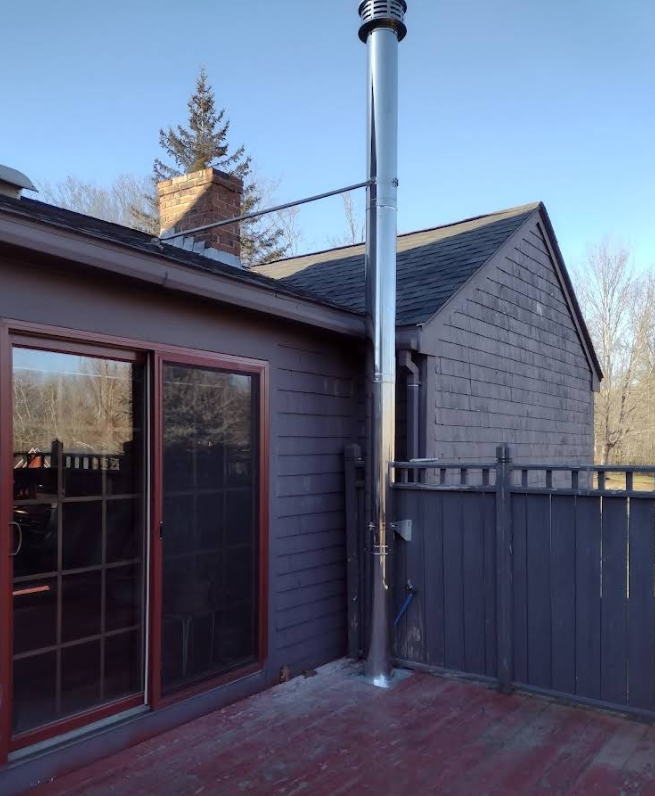
The National Fire Protection Association (NFPA) and the International Residential Code (IRC) set the building code standards for chimney construction, including height. For all residential chimneys, they must be 36” above the point where they pass through the roof AND 24” above any structure within 10 feet of the chimney. The drawing below helps to understand this better.

The height of the chimney affects the draft (the way the chimney pulls air up and out from the home). A chimney that is too short can affect the draft and can cause smoke from fireplaces to enter the room. It can also make it more difficult to light a wood stove. In addition, the minimum height requirements of the chimney help protect the roof from catching fire from sparks and/or burning embers that may make their way up into the chimney.